Saturday, 13 December 2008

Storyboard

Below is a stroyboard of the shots we took:


Monday, 8 December 2008

Shot List

Below is the shot list for the opening sequence of Alone?:


Location Sheet

This is the location that we are going to be using for filming. It is Lauren's House which is located in Warrington. We will be using various rooms within this house including the bathroom, the stairs and hallway, and the living room.

Sunday, 23 November 2008

Questionaire Results:

In this post there is the results and analysis from our questionnaire.

For the first question, we asked whether our audience was male or female, this is important as males and females can often have quite differing tastes when it comes to films .

Photobucket

15 members of our audience were male and 17 were female, which is pretty well balanced.

As a result of this we decided to make our film suitable for both a male and female audience.

The second question we asked was how old our audience were, this is important because we need to know what age certificate to give our film an therefore what age our film will appeal to.

Photobucket

The majority of our audience were between the ages of 17 and 18, but it was not a large majority, only 4% less of our audience were between the ages of 15 and 16.

We therefore decided that our film would have a 15 certificate rather than an 18 certificate, so that we did not exclude the younger members of our potential audience.

The third question that we asked was what genre of film our audience preferred, this was important information for us to get so that we knew a general idea of the different film tastes of our audience.

Photobucket

The favourite genre of film within our audience was the thriller genre.
This is good information to know, as we are making the opening to a thriller and so it should be popular with our audience if it is done well.
The fourth question that we asked was how much gore our audience members liked to see in a film, this was important to know because from this question we could gage exactly how much gore content to put into our film.

Photobucket

The most common response from our audience was that they liked a bit of gore in a film, but not too much.

This made us come to the conclusion that we would possibly put in a few elements of gore into our opening but not alot.

The fifth question that we asked was whether or not our audience liked that edge of your seat feeling, that you get from watching some films, this was important for us to know so that we could either have this element within our film or not.

Photobucket

The majority of the audience said that they liked being on the edge of their seat whilst watching a film.

As a result of this, we decided that we would use the edge of your seat concept in part of the film, but not in the opening sequence.

The sixth question that we asked was whether or not our audience likes having puzzles and things to work out whilst watching a film or not, this is important for us to know as it could be an essential part of our film.

Photobucket

The audience said that they did like having things to work out.

As a result of this, we decided that our film is going to contain lots of engima codes and things for our audience to figure out as the film goes on.

The seventh question that we asked was what could a possible title for our thriller film be

The suggested names were:
Chasing
Love Story
KILL KILL KILL
Watching Daisy
Mysterious
Stranger
Alone?
Thrillville
The Hand
Whiteboard
Stalking
Scar

After discussing potential storylines together in our group, we decided to call our film 'Alone?'

We feel that this title best sums up the story of our film, which will be revealed in the treatment, which can be read in a previous blog post.

Character Profile.

Edward Burns:

Edward Burns is a 25 year old mental patient at the MIOS Hospital, Manchester. He's been living at the hospital for five years.

Growing up, Edward was raised in a big house by his Mum and Dad (Sarah and John Burns) he had two younger siblings, Jenny and Joe. He didn't have a very good childhood, despite his wealth. His parents were extremely strict with very high standards. They wanted to raise the perfect son. Edward being the oldest was the one that they beat down hard on. They sent him to the top schools in London to which he was but an average student there. Edward's home life, however, was far from great. When he was the mere age of eight his father started sexually abusing him and beating him within an inch of his life for getting 'insufficient' grades such as B's and C's. Growing up, Edward turned very bitter towards his family. His mother did nothing to stop her husband treating Edward the way he did, she saw it as 'correct disciplinary rules'. She knew what her husband was doing to their eldest son and stood back and did nothing. To the eyes of their neighbours the Burns family were a very well kept family. Everyone looked up to them and admired their wealth and power. Sarah liked the attention she was getting and wouldn't jeopardise that reputation by putting a stop to the horrible 'fathering' of Edward. Edwards younger siblings grew up completely unaware of their fathers ways of 'teaching' and were therefore completely innocent to what their older brother had to put up with and were baffled by his shy, hide-away nature. However, Edward thought they all knew and enjoyed to watch him suffer therefore hiding himself away and growing apart from his family. He tried to escape many times but, due to his fathers wealth and power over the local society, he was always found, beaten within an inch of his life, 'attacked by someone on the street' and sent to the nearest hospital for treatment.

Before Edward was brought to the MIOS Hospital he ended up in the Liverpool General Hospital numerous times covered in full body bruises and a face full of blood. He stayed quiet about the attacks and no body knew what happened to him. Everyone was completely unaware of Edwards home life or where these bruises were coming from. His parents paid for his recovery and to be treated and he was eventually sent home after every visit. Every time Edward would return home the Liverpool General would get calls from his parents about Edward having manic fits, shouting, screaming and the last call received was a terrified mother calling for the police because Edward had pulled a knife out and held it to his sisters neck threatening to kill her.

That's when he was brought to MIOS. At the time of his arrival at MIOS, Edward was 20 years old. The doctors at MIOS declared Edward insane and he's lived there ever since. He still wakes up of a night shouting and screaming incoherently. Only one word can ever be correctly heard. 'Alone'

Alone? Script.

INT. BATHROOM. NIGHT.
First, we get an angled mid-shot of the shower curtain. JENNY is whistling in the shower. Water is running. The main credits start rolling across the screen.

INT. HALL/LANDING. NIGHT.
Panning shot of JENNY walking out of the shower following her feet from the bathroom to her bedroom. JENNY is whistling throughout.JENNY comes out of the bedroom, fully dressed, for a night out with the girls. JENNY walks down the stairs, makes a cup of coffee and turns on the t.v.

INT. LIVING ROOM. NGHT.
T.V is turned on by JENNY. T.V Broadcast.

TV PRESENTER:
And now for tonight's top story. A mentally ill patient from the MIOS hospital in Manchester escaped three days ago. Police are still on the lookout but there is still no sign of him. Doctor's from MIOS are extremely concerned for the welfare of anyone he meets as he is, at this point in time, extremely unstable and could cause a major upset. Coming up on your screen is a picture of the patient who's name is Edward Burns. If you come across this man or see him anywhere, the doctor's at MIOS urge you to advice the police of his whereabouts right away as he can be a danger to you and himself...

JENNY cuts off the T.V before the picture is shown.
ZOOM IN to JENNY's face to show the shock and realization.The lights flicker off and on. There's a knock at the door. JENNY anxiously walks over to the door. Camera follows behind her with a tracking shot. JENNY walks right out to the edge of her road.

CUTS TO EDWARDS's POV running inside the house, looking back at JENNY and up the stairs.

BACK TO JENNY. Long shot of her walking through the hall towards the camera looking nervous. There's a bang upstairs and she turns around nervously. REVERSE-ANGLE EDITING to show her reaction.

JENNY:
Hello? ...Is anybody there?...*shakes head and turns back to the living room*

EDWARD's POV shot from behind JENNY as he sneaks up behind her. EDWARD grabs JENNY from behind, puts a chloroformed cloth to her mouth and drags her through the hall and out the door.

The End.

Saturday, 22 November 2008

Treatment for Alone?

Alone? is a mysterious film. A tension building mystery of a mentally ill patient on the rampage.

Synopsis.
A deranged mental patient from the MIOS Manchester Hospital has escaped and is on to the rampage to continue his journey in killing the remaining members of his family. Will he succeed? Only time will tell.

Plot Outline
Beginning: Jenny Burns is getting ready for a night out with her girlfriends when she is presented with a shock from her past.

Middle: Edward Burns (mental patient) successfully kills four members of his family. Jenny his sister, Sarah his mother, Joe his brother and Jackie his aunt.

End: Edward Burns is on his way to kill his 'beloved' father. The police are ready to capture him. Last shot is Edward manically laughing in the middle of a white room, wearing a straight jacket.

Opening scene.
We begin with a mid shot of a shower curtain. Jenny is whistling peacefully. She gets out the shower and gets changed. She has 15 minutes to spare so she makes a cup of coffee and turns on the tv. She gets the shock of her life when she hears about the escape of her mentally ill brother Edward. She turns the tv off and the lights flick on and off. She hears a knock at the door and walks anxiously towards the door to check. Edward sneaks in through the door when Jenny walks towards the main road and he runs upstairs. Jenny returns inside and locks the front door and hears a noise from upstairs. Suddenly Edward grabs Jenny from behind and puts a chloroformed cloth over her face and drags her through the hall and out the door.

Target Audience.
The film should not be viewed by anyone under the age of 15 as the film has disturbing images and situations. Because of this, our group decided on a 15 certificate. This film should appeal to young adults and adults. Our film contains no graphic violence or sex but it does hint at sexual abuse.

Audience research.

QUESTIONAIRE:

As part of the preparation towards creating our own thriller film as a group we devised a questionnaire, which we then gave out to our potential audience.

After we had got our results we analysed them.
Analysing our results then helped us come to some conclusions about how we are going to make our film.

The questions that we asked were as follows...
Are you Male or Female?
How old are you?
What genre of film do you enjoy most?
Do you like seeing gore in films?
Do you enjoy being on the edge of your seat whilst watching a film?
Do you like having puzzles and things to work out whilst watching a film?
Do you like a film sequence that makes sense or one that you have to work out?
What name for a thriller film would grab your attention?


In our assigned groups in which we will make our own thriller openings, we had a discussion about the common conventions of thrillers and put them into a list as follows.

They are often filmed at night to create a mysterious atmosphere.

The villain is often present but his/her identity is not often revealed until the end or near the end of a film.

Enigma codes are used to create questions in the minds of the audience.
POV shots are often used to show the villians POV, but to conceal their identity using partial vision.

Eerie music is often used to build up tension and create a sinister atmosphere.

The music often builds up to a dramatic climax, when something crucial happens in the film.

The credits always come in a set order - going from the actors to the crew to end with the director.

Linking to the ideal of partial vision there is lots of close ups to prevent the audience from seeing crucial elements in the film.

They often give you a teaser or puzzle to figure out during the film.
The films often start by showing the villain doing something strange or mysterious.

A combination of the colours black, white and red are most commonly used in the title sequence.

Often they contain a sequence of events leading up to a climactic moment, where the hero/heroine is in some kind of danger or trouble.
Shadows are often used to create more mystery/tension surrounding the villain.

Foreshadowing is used to predict future events in the film.

Friday, 21 November 2008

BBFC Classification Rules

15' - Suitable only for 15 years and over.
No-one younger than 15 may see a '15' film in a cinema. No-one younger than 15 may rent or buy a '15' rated video or DVD.

Theme.
No theme is prohibited, provided the treatment is appropriate to 15 year olds.

Language.
The may be frequent use of strong language (e.g 'fuck'). But the strongest terms (e.g 'c*nt') will be acceptable only where justified by the context. Continued aggressive use of the strongest language is unlikely to be acceptable.

Nudity.
Nudity may be allowed in a sexual context but without strong detail. There are no constraints on nudity in a non-sexual or educational context.

Sex.
Sexual activity may be portrayed but without strong detail. There may be some strong verbal references to sexual behaviour.

Violence.
Violence may be strong but not dwell on the infliction of pain or injury. Scenes of sexual violence must be discreet and brief.

Imitable techniques.
Dangerous techniques (e.g combat, hanging, suicide and self harming) should not dwell on imitable detail. Easily accessible weapons should not be glamorised.

Horror.
Strong threat and menace are permitted. The strongest gory images are unlikely to be acceptable.

Drugs.
Drug taking may be shown but the film as a whole must not promote or encourage drug misuse.

Thursday, 20 November 2008

Sweeney Todd Opening.

Photobucket

Photobucket

Narrative Structure:
Sweeney Todd has a pretty straight-froward opening sequence, the whole sequence is filmed continuously and it follows a linear structure. The sequence is the beginning of our adventure with Sweeney and Mrs. Lovett. We are introduced to the gore straight away as we are following the journey of a blood droplet into the pies of Mrs. Lovett this is hinting/foreshadowing gore and violence already.

Thriller Codes and Conventions:
Like all thriller films Sweeney Todd is no different, it may be a little gorier then most but it still has its conventions and codes. Enigma codes are used straight away as the audience is led to ask 'why are we watching a blood droplets journey?' 'who's blood is it?' etc. The blood in itself is a convention as people immediately think 'what's happenend?'. The scene beginnings with an over-head shot of the surrounding town. It's dark and stormy. This is a frequent thriller convention. Throughout the sequence is tension building music that just gets louder and louder as the sequence continues hinting at troublesome things to come.

Camerawork:
We are firstly given a long shot of the surrounding town and buildings. Then, as the sequence begins we track alongside all the buildings to show the dark, dank atmosphere and the extent of the storm. The sequence has lots of zooming in and out at certain points to pin-point important objects to the plot of the film, like for example Mrs. Lovett's pie maker and the blood-red water. We are presented with an ECU of the meat grinder as that is where Sweeney himself puts all his dead victims and hoe Mrs. Lovett gets the meat for her pies.

Mise-En-Scene:
We are presented with a misty, cold, wet, dark and stormy setting. This is a typical thriller conventions and links to make for an eerie, tension building plot line. The blood droplet we are following is a vivid red and its the only thing we can look at. The meat grinder is an important aspect to the plot. Darkness surrounds Mrs. Lovett's pie shop and Sweeney's barbershop.

Sounds:
Sweeney Todd has a variety of sounds that work well and contrast well with eachother. Firstly, we get the tension building music to set the scen, then as we follow the blood along its journey we meet obstacles that move, these obstacles such as the meat grinder and water make noises which overlap the music and mis in well to create tension. The music we have is very organ-based and orchestral. This carries serious connotations, the issues presented in this film are very serious issues- it's dark and direct.

Photobucket

Wednesday, 19 November 2008

Hannibal Rising Opening.

Photobucket

Photobucket

Narrative Structure:
The narrative structure in Hannibal Rising is general but does contain some flashbacks and is not strictly linear, but it does follow a continuous flow, just broken up with flashbacks. However, in the opening , it is chronological because even though what we are seeing is Hannibal's past we have not seen ahead of this time yet.

Thriller Codes and Conventions:
The thriller conventions are how the audience is shown a spiders web and silence of an undisturbed forest. The close ups on the water and leaves is an example of partial vision as the viewer is only being shown a selection of what is happening. Children on their own can also be a convention as it makes the audience consider whether the children are safe. The explosion and the urgency of their parents to get on the road is also a convention of a thriller as the viewer is wondering what they are running to hide from. Although there are clues e.g. planes, Nazi flags. The reassurance the father is giving the children seems more for the benefit of reassuring himself as the children, especially Mischa, are still too young to understand properly. This reassurance also helps the audience to understand what is going on and why they are running away but still creates many questions as to why they are being targeted and if there is any particular reason or if it really is just a random Nazi attack.

Camerawork:
The cinematography of the scene begins with close up shots of the forest, the audience is only shown so much. In contrast to this we see some wide shots of the river and the buildings, this is when the mood of the scene is calm. However, when we hear the sound of an explosion the shots become a lot closer again and the angles they are shot from are sharper, this creates an edgy atmosphere for the viewer.

Mise-En-Scene:
In the way of costumes and setting this shows the audience that the film is get the 30’s during World War II. The house they live in and amount of bags they take also show that they are a wealthy family. The performance of the children shows very clearly that they are inseparable and that Hannibal is very protective of his sister Mischa, we later learn that this is crucial to the story.

Sounds:
The first sounds we hear typical noises of the forest alongside vocally created angelic sounding music and soft wind instruments. This calmness flows the children’s laughing which contrasts to the explosion and birds flapping their winds disturbed the mood changes along with the sounds we hear fighter planes overhead and a horse’s neigh. The music becomes tension building and bombs and guns go off continuously in the background. When they are in house we think that they are safe as the music is a lot softer and there is less background noise they are just a family again.

Editing:
The cuts begin slowly and transitions allow shots to flow into one another they continue to do this in a roundabout way when we see the children playing on the dock but we are shown more angles this time. Cuts become more choppy and frantic when the bomb goes off and they're running away. These short, sharp cuts are representing the urgency that the family have to get out of their house.

Graphics:
Hannibal Rising, the title is written in capital letters and in a serif font and gradually appears onscreen. The lettering comes into view almost from out of the mist and dissolves away as if into the water.

Photobucket

Photobucket

Silence of The Lambs opening.


Photobucket

Photobucket

Narrative style:
The narrative style of Silence of the Lambs is completely a continuous one, it follows a linear narrative style throughout. It's done this way to represent a journey that our main character is going on. We follow her journey through an assault course. We have a beginning, a middle and a defining end. The beginning is our main character running through her assault course and being called away by a man in a bug FBI hat. The middle is her journey through the place that she works and we get a glimpse of where she works and what she does. It end with an important part of the film. We learn for the first time that she is a detective about to be given a very serious case to work out. Who is Buffalo Bill? It ends with a question.

Thriller Codes and Conventions:
We are presented with a variety of different questions, these being the enigma codes. Where is she running? What is she doing? Who is the killer? etc. We also have the thriller code of 'mazes and labyrinth' as she is running through the assault course, because, at first, we have no idea why she is running or where she is going. The setting of the opening scene seems is a darkened, misty forest. I believe it to be maybe early morning? We also have our eerie music throughout the running.

Camerawork:
We are given a wide variety of shots in this opening sequence. We are firstly presented with a long shot of the surroundings to give us a feel of the atmosphere and where the setting is. Then we are tracking alongside the main actress following her as she runs. Then we get a close up of her feet to quicken the pace of the film. We then get a POV shot from behind which gives it an eerie feel as if something is following her, but not. When our actress sees the wall at the very end of the sequence we get a close-up of her face. This shows the realisation on her face as we see her reaction to the wall of horrifying and disturbing pictures of recent victims.

Mise-En-Scene:
Our main character is dressed in running gear, which doesn't fit the stereotypical view of a woman in the films. Woman are suppose to be dressed up and made look beautiful not sweating in grey sweats. This subverts our expectation by having 'Starling' wearing quite a manly costume. The forest in which she is training in is really misty and that helps create an eerie atmosphere. We see a sign up on the wall it says 'Hurt. Agony. Pain- Love it' this is ironic as it could easily signify the villains motif, however, it looks to be the motto of the FBI. We also see that, in the lift scene, our main character is wearing grey in the lift and is being towered over by many big men in red behind her. Her work place is very male dominated whilst she is a woman and again, this completely disregards all forms of stereotypes to woman.

Sound:
From the very beginning we have a very orchestral tune- this has serious connotations to it and usually means that this film is going to contain very serious issues in it. The music is quite calming, but quite clearly to build up tension. Over the music we hear the slight chirp of little birds, an eagle flapping its wings and crickets croaking, all adding to the build up of tension and to create a calm, but slightly eerie atmosphere. They are all natural noises. We have the deep breathing from 'Starling' and her the noises her feet make as she's running, again, to add to the tension build up. As 'Starling' reaches civilisation the music changes it's key and it doesn't sound as sinister. However, when the realisation of the wall sinks in and we get that zoom to her face the sinister music kicks in again to add to the fact of realisation.

Editing:
We have a continuous editing throughout. We get what is called 'reverse angle editing' ans this is when it zooms onto our actresses face, this is what helps the audience to understand her realisation about the killer. The editing is very slow-paced throughout to show the seriousness of the film or the issues it contains.

Graphics:
We are given black credits over a screen shot, all in block capitals and white a white border to make it easier to read as its on the screen. It's also centered.

Photobucket

Red Eye Opening Sequence.


Photobucket
Photobucket

Photobucket

Narrative Structure:
The narrative structure for Red Eye is a continuous structure. The storyline of the opening sequence is one big question. We are given hints that something bad could happen and we have our mystery man as he steals this girls wallet. Is he a criminal? We ask. We don't know. There are two main scenes during the opening of Red Eye. One is the mystery man who's face we never see. He steals this girls wallet, takes her credit and debit cards and throws them away but leaves her picture in it. The second scene is a group of men moving some form of cargo. We get the impression that whatever it is they are moving or transporting is illegal products as it's been hidden in a frozen fish box.

Thriller Codes and Conventions:
The opening sequence is one big enigma code. It's jam-packed full of questions. We are continually asking 'who is that man'?, 'why is he stealing that girls wallet?', who are these men?', 'why are they transporting and why?'. The sequence is also filmed at night time. We are presented with partial vision with the fact that we never see our mystery man's face. We don't know who he is, whether he's good or bad or whether the men transporting something are the bad guys. One of them, obviously, is the a bad guy of some sort as the impression we get from the music and what they're doing seems suspicsious.

Camerawork:
We are given a lot of traccking shots, following our main mystery man and the girl who's wallet he steals. We get ECU's when he's looking through her wallet, again, to conceal his identity and so we really pay attention to what he is doing as it may be important later on in the film.

Mise-En-Scene:
We are given lots of pictures to look at, mainly of a young, teenaged girl. She might well be the main character, but from the opening sequence we're not too sure as we hardly see her, apart from when she puts down her wallet. Outside is night time, this is another main thriller convention. We're also given an ECU of a map or some sort. Could it possibly be an escape route? We're not told. Hence, the use of questions needing answered.

Sound:
To begin with we here an aeroplane taking off noise. This could signify that the main action takes place on a plane. We're also provided with some up-beat music everytime it cross-cuts to the group of men transporting cargo (?) this could possibly signify the troublemakers or what they are doing is some form of illegal activity. We also have a build up of tension and a jumpy moment when our myster man grabs the girls wallet to signify an important moment in the sequence.

Editing:
The editing is very quick-paced and in some points jumpy. This could be to signify important aspects of the film. It also has a continous flow. It cross-cuts from the mystery man and the group of men many times to show what's happening at both times, and possibly to show that this is happening at the exact same time.

Graphics:
The credits are in a form of type-writing style and are centered, but they do move around the screen at different points. The title of the film id centered and in a very bold writing. It is also red, this is ironic as the title of the film is 'RED Eye'.

Photobucket

Sunday, 16 November 2008

Jaws Opening Sequence


Photobucket

Photobucket

Narrative Structure:
The narrative structure of Jaws is linear and chronological, we see the events happen one after another in the order in which they happened. The scene is created in three parts. A beginning and middle and an end. The prologue of the opening sequence is like a miniature story that leads up to the main story. The beginning and ending of the opening are broguth back to an equilibrium; everything is calm and peaceful.

Thriller Codes and Conventions:
There are many codes and conventions of a typical thriller in Jaws, this being the tension filled music, the female character being the victim, screaming, having the other character – who could possibly save her- being unaware that anything is wrong. The girl, thinking she is safe when she gets to the buoy but she is not and the shark attacks her again. We also have the use of enigma codes where the audience is lead to ask many questions like for example when we get that POV shot from the shark we , as an audience, automatically ask, 'what is watching the girl?', 'Is it dangerous?' etc... Also never seeing what is attacking her is an example of partial vision this fear of the unknown a typical convention of a thriller.

Camerawork:
The cinematography in the scene where the audience has the view point of the shark is giving the audience an idea that she is not safe and which direction the danger is coming from. The wide shots of the sky and water also show how it was easy for her to think that the water is safe because nothing looks out of the ordinary even from the widest point of view.There are few props in the opening apart from the fire, showing that it is almost night time and how there will not be many people around. Also the setting gives the audience an idea of the location of the film.The sound we hear in the opening of Jaws are the tension building music leading up to when the girl is being attacked in the water and the loud drum beat accompanying the attack which stops abruptly when the girl goes underwater for the final time.The editing of the sequence when the two teenagers are running to the sea and when the girl is being attacked is shown in quick fast paced, frantic cuts of shots from different angles. In contrast to the calm, static, lingering shots of the boy who has fallen asleep on the beach.

Mise-En-Scene:
The opening sequence is set at night time/evening time. It is filled with young students having a beach party carrying out troublesome tasks like drinking, smoking and kissing excessively. (Sex, Drugs, Rock and Roll). The fire in the opening scene is the only bit of light throughout the sequence. It creates a great contrast between light and dark and creates shadows. It also shows the contrast between the size of the fire in comparison to the ocean, so that could create a sort of fore-shadowing in the sense that something bad about to happen involving the great, big ocean.

Sound:
The beginning starts very quietly, then the middle part where the tension is building the music/sound becomes gradually louder and louder until the climactic ending becomes silent again. The silence at the end is a good representation of death. The screaming ans splashing about when the attack is happening is a great contrast to the boy lying peacefully on the sand near her. You kind of expect the boy to hear her struggle and the audience get a glimpse of hope that the boy will come and rescue the girl, but when that doesn't happen, the shark successfully kills the girl and the scene becomes silent once more.

Editing:
Continuity editing is used throughout to help with the flowing of one scene to another. Match shots and shot reverse shot are used between the girl and the boy to show the sexual attraction between the two. Cross-cutting is used during the attack scene when it cuts back to the boy laying peacefully on the sand. This gives the audience a slight glimpse of hope that the boy might actually rescue the girl. Also, at the very end of the sequence two shots are dissolved into one. An early night shot is dissolved to a late shot to show the passing of time.

Graphics:
The title is in block capital for emphasis. They credits are on screen as the film is playing and are centered in the middle of the screen.

Photobucket

Sunday, 9 November 2008

Seven's opening sequence.

Photobucket

Photobucket

Narrative Structure:
Seven doesn't have an obvious storyline as it's narrative structure is very much fragmented and distorted. It is believed to be a glimpse into the mind of our villain. Seven gives hints of a storyline, yet, the audience are left to put the pieces together and basically, make a calculated guess as to what the story is about but setting up the story but not in a conventional way. The narrative structure is non-linear which confuses the reader by having no clear narration.

Thriller Codes and Conventions:
Seven has a constant flow of enigma codes. It is continually making the reader ask questions at any particular moment. Like for example; 'Who is cutting his fingertips off?' 'Why is he cutting his fingertips off?' . The many thriller conventions in Seven are all obvious ones. The audience is blinded in many spots in Seven. So the term 'Partial vision; fits in well with this sequence. The audience is only showed certain images and scenes as this create a lot of tension and keeps the audience guessing as to who the villain is and why he is doing it. The lighting in Seven is very dark, and uses the main colours black, white and red. All of which, put together, have quite dark/dangerous connotations.

Camerawork:
As Seven has a non-linear structure it doesn't have a flowing storyline so the camerawork is mostly images jumping from one to the other. There are lots of ECU's (extreme close-ups) as this helps with the partial vision convention by restricting the audiences view and it keeps the villain a mystery. It also creates a focal point and gives us a clear view into this characters deranged and meticulous mind as we get to see exactly what he is doing and, through this, the audience are having a nasty relation with this character as we get to see all these disturbing things up close. Throughout, the camera is almost always still, this emphasizes the shocking images on screen by keeping us completely still whilst watching these disturbing images.

Mise-En-Scene:
The main feature of Seven's opening sequence is the continuous image of this mystery character writing in his book. There are pages and pages of writing, this creates an uneasy tone as this character is obviously very obsessed with his task and the connotations of writing lengths that long are intelligence, this character gives off a very intellectual vibe, he obvious knows what he is doing and exactly how he is going to do it as he's written pages and pages about it. All the images we are shown have some form of sharp object in them, this emphasizes the danger this character is. He has an obsession with sharp objects like, scissors, pins, needles, knives and blades. These all have negative connotations and are, most of the time, associated with the villain.

Sound:
All the sounds in Seven opening sequence aren't normal or natural sounds. Even the screaming in the opening is distorted to make the scene more creepy and disturbing to watch. Underneath all the weird sounds we have creepy music playing throughout, this helps create a sinister tone and mingles well with the distorted image. All together the images and sound, both distorted as they are help the audience to see a clear view into the villains mind. He is not a normal villain, he is a man with a mission and whatever his mission is he has a purpose for doing it and will stick with it until it's over. It's an obsession. The noises we hear are all of a low pitch or a very high one, the two contrast well to create this huge build up of tension. The ending line of the song 'You got me closer to God' this links in with the villains motivation throughout the whole film as he describes in one scene that the reason behind these murders are because God is talking through him, and that he is following the will of God.

Editing:
The shots in Seven are very much overlapping in every part of the sequence, when this happens its called 'dissolving' the shots dissolve from one shot into another shot. They are superimposed on top of one another. This helps create that creepy background and makes the images seem jumpy, this is what gets the audiences attention. The editing doesn't follow a continuous flow, in fact the editing in Seven is a montage editing, this is to create a broken up sequence of images. Subliminal editing is also used, this means that one shot is on the screen for a very short amount of time and most of the time these will be the big clues so the audience will miss most of them and this leads them to ask questions.

Graphics:
The credits in the opening sequence of Seven are white on a black background, this is to make them stand out, they also follow the way the sequence is made by jumping around and flickering on the screen, this links with the distortion of images and continues that creepy sort of fragmented image in the villains head. They are also quite scratchy looking which links directly to the villain as we know he writes a lot of things down so there is an obvious link there. Big actors names come first, and the director's name is always last as that person is said to be the most important.
Photobucket

Wednesday, 22 October 2008

SEVEN

We watched the thriller film 'Seven' in lesson. I'm now going to apply the theories we discussed in lesson to what we saw in the film. See if we have any matches:

G.K Chesterton: The transformed City.
The setting for 'Seven' was an urban type setting. The city in which it was set was a normal city that was transformed from a to be 'the city of sins'. This is where the city became a well-known city of death.

Northrop Frye: The Heroic Romance.
Brad Pitt's character 'Dave Mills' was an ordinary cop working in a city full of crime. He was eventually transformed into the seventh deadly sin. This, therefore, follows the theory of Northrop Frye, whereas, someone who's quite ordinary turns extraordinary.

John Cawelti: The Exotic.
The theory of John Cawelti is applied here as these normal people, just living thier lives as they normally would, were killed for commiting one of the 'seven deadly sins', hence the exotic element is now present. As people are accustomed to puzzles and mazes the use of the sins as part of the puzzle is a great factor in the film.

W.H Matthews: Mazes and Labyrinths.
The puzzle of this film would be the seven deadly sins that the villian in this film is basing his kills on. He tells us towards the end of the film that the reason behind his killings of these 'innocent' people is, in fact, 'God's will'. He believes he was chosen by a higher power to commit these murders in the name of God. This leads the audience to ask many questions. Hence, the puzzle is set. Also, the fact that the killer is not actually seen until the end of the film creates a nice mystery as the audience is left wondering his appearence throughout the film.

Pascal Bonitzer: Partial Vision.
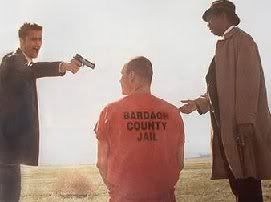
Bonitzer believes in the theory of 'partial vision' this is the theory that the audience isn't been provided with absolutely everything. In the film 'Seven' the audience are kept in the dark about a few clues and killings. The clues left behind by the killer are obscures slightly to our view. We are read them but don't have much time to fully understand them. Also, the fact that we never actually see the killer till the end is an obstruction. At the end the box is opened and inside the box is 'David's' wifes head, yet we, as the audience, don't get to see the head.

Noel Carroll: Question and Answer.
The audience, throughout the film, are given many puzzles to overcome, therefore leaving us to ask many questions. In 'Seven' when we learn the plan of the killer and his kills are actually based on the seven deadly sins we are always asking ourselves 'which sin will it be next murder?'. We are also asking ourselves 'why is he doing this?' to which we are granted an answer which is 'it's God's will'.

Roland Barthes: Enigma Codes.
Barthes believes in the idea of codes that every thriller must follow. This is the moment in the film where the audience is led to ask questions. Like for example the part where the murders happen, we are led to ask 'by who?, 'which sin?', etc.

Saturday, 18 October 2008

What is a Thriller movie?

Brief:
Film the opening sequence of a new thriller, including titles, aimed at 15 or 18 certificate audience (approximately two mintues in duration)


To begin, we, as a class, discussed our general ideas and thoughts on the characteristics of a thriller film. These were our results:


Dictionary term for 'Thriller':
"Thriller is a loose genre term referring to any film that generates suspense and excitement as a major aspect of its narrative.".


We then looked at a few theories concocted by other people.

G.K Chesterton, an early 20th Century writer of thriller stories argues that thrillers took urban settings and transformed them into exciting locations for dramatic stories. A modern example of this in film is "Panic Room" because the whole concept is this panic room and it'd transformed a normal room into a room of terror.


Northrop Frye, author of "Heroic Romance" , argued that thrillers were stories that took ordinary people and threw them into extraordinary situations. Another example in film would be "Spiderman" because Peter Parker was on ordinary person who got bitten by a radioactive spider and thrust into the limelight.

John Cawelti, author and pioneer of modern culture said that thrillers took the elements of ordinary lifes and added an exotic element. An example of this would be "James Bond" because he is a man with an extraodinary job.


W.H Mathews had a fascination with puzzles and mazes and the theory of mystery he felt that thrillers included these factors and also included the characters having to get to the bottom of puzzle or the audience members questioning what was happening. An example of this would be "Cube" the whole film is like a huge maze and the audience have to ask questions throughout asking how they got in there and 'how are they gonna get out?'

Pascal Bonitzer an award winning teacher at The French school of Film thinks that thrillers give the audience a partial view of the situation and important details are obscured in many ways. Through information being withheld and images etc. "The Dark Knight" is a good example of this because the audience are kept from seeing the Jokers true face.


Noel Carrol thought that a good thriller was structured around a series of questions of which the audience is led to want answers from the movie.


Roland Barthes, a French literary critic analysed all narratives and realised that all narratives included enigma codes that operate moment by moment. Enigma codes are parts of a narrative when the reader is led to ask a question. In thrillers enigma codes are very important for telling the story in a suspenseful way. A good example of this would be "Seven" when at the murders the audience are led to ask many question like 'which sin was it?', 'how were they killed?'.

Preliminary Task Feedback.

What the examiner will be looking for:
- steadiness of camera
- framing of shots
- 180 degree rule
-match on action
- shot-reverse-shot.

Our task:
'So, why did you do it?'

-great match on action
-good use of 180 degree rule
- shot-reverse-shot needs work
(in one frame Matt was still moving, yet in the next shot of him he had stopped moving- keep it flowing)
("'Coz I'm 'ard, sir' -Ric was too far left in the shot, he needed to be more to the right)
(the position of Ric's head didn't match in one the first shot to the next)